Clay tile manufacturing

Tileries today are large non-polluting industrial units. A little known fact is that the factories are very much high-tech.

Here are the different stages in the manufacture of a clay tile. :
Extraction of the clay

 
The clay needed for the manufacture of tiles is extracted from open quarries
 
All clays do not all have the same properties.
 
From clay to the "green tile"

The selected clays are crushed, rolled and mixed.
Water is then added to the clay to assist with the moulding process.
Most of the air is then extracted under high vacuum and a ribbon of pre-formed clay is drawn through an extruder.

Cut into individual pieces called batts and pressed into the shape of the model being produced.
On leaving the press the
On leaving the press the "green tile" is transferred to the drying area
The level of humidity is then reduced to 3%.
Drying and firing

 
From the dryer, the tiles are placed on individual cassettes which are then loaded onto wagons and transferred into the kiln.
 
The tiles are fired using computerised controlled kilns at temperatures of over 1000°C (1832 °F).
 
Quality control and storage

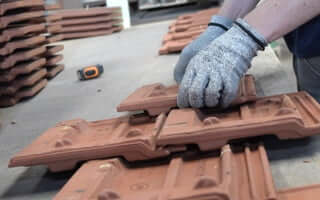
Once fired the tiles are removed from their cassettes, sound and visual checks are taken manually before moving to the palletization area.
Palletization is entirely automated (bound in bundles, pallets are shrink-wrapped...)
Samples are regularly checked by the Quality Assurance Personnel. Once the production is passed by the QAP the products are put on sale.
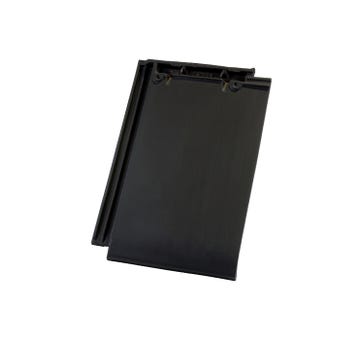
HP10 Slate
Services


Documentations